Resources
Gaussian Splatting handbook
From a good capture to a useful 3D environment. A practical guide to capturing a space and understanding what happens to the data afterwards. The handbook is in Dutch.
Download the Dutch handbookPDF · Dutch · 64 pages · 5 MB · Version 8.0
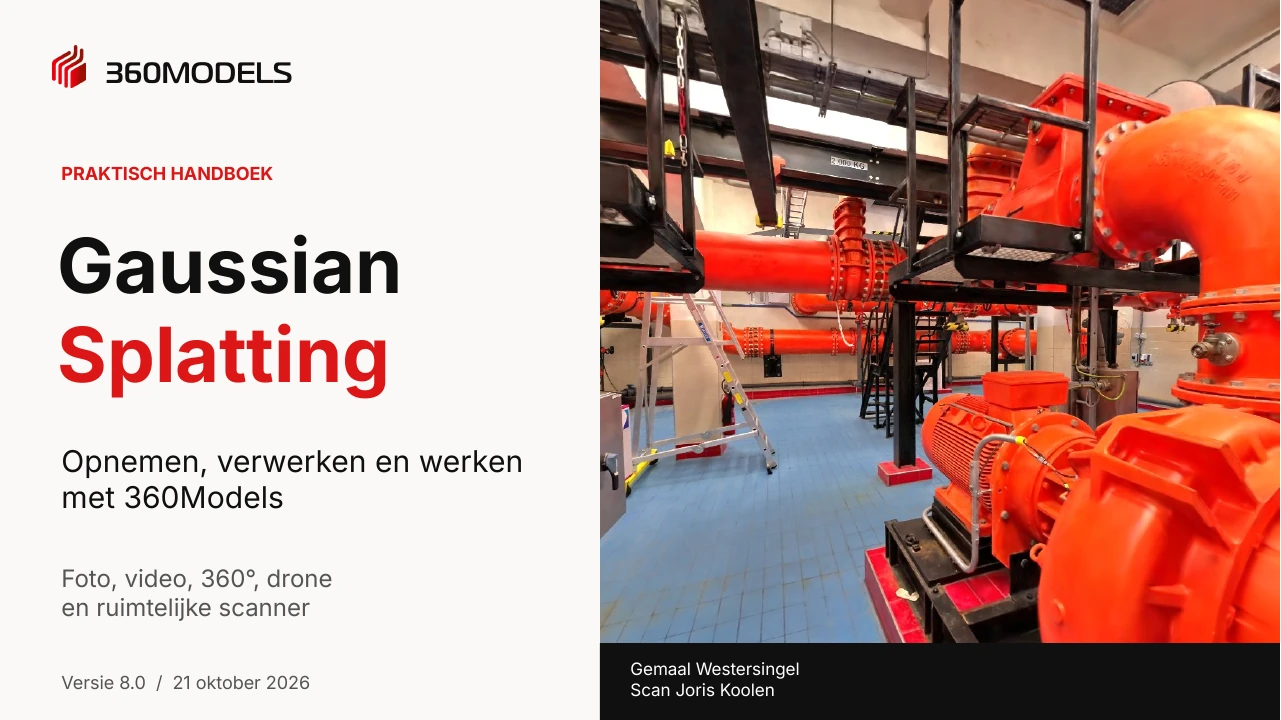
From capture to use
Gaussian Splatting (3DGS) reconstructs the appearance of an object or environment from overlapping images. Small, coloured 3D elements with shape and opacity, called Gaussians, form a photorealistic representation you can explore from different viewpoints.
Capture the scene
Choose between photos, video, a 360° camera, drone or spatial scanner. Find practical guidance on capture routes, overlap, lighting and on-site checks.
Process and assess quality
From source files to reconstruction. Learn what to check for coverage, detail, alignment and file size, and which file formats serve which purpose.
Work with 360Models
Manage, view and share your environments. Add annotations and documents, prepare work remotely and make the results available in your own software.
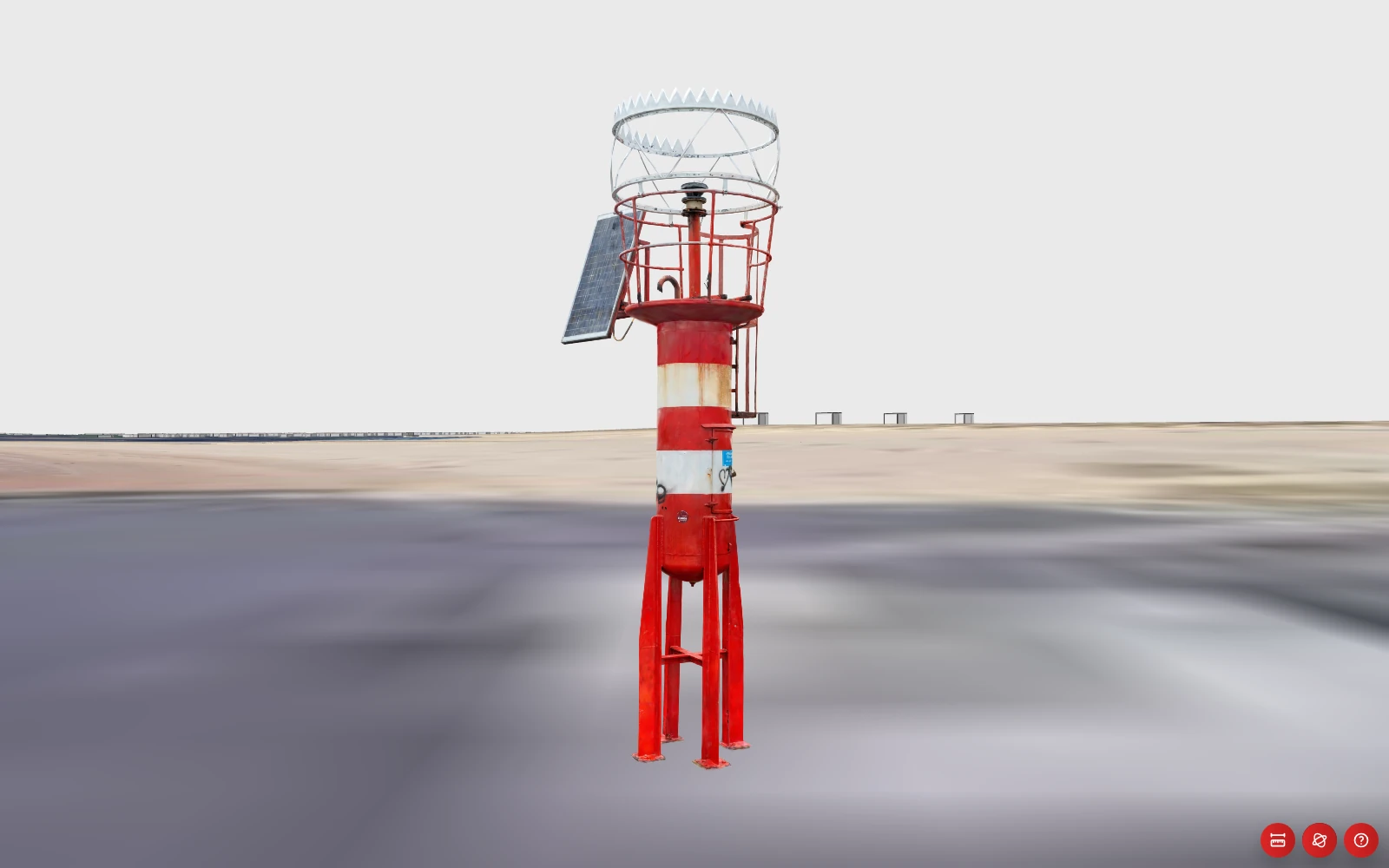
See it for yourself. Explore the lighthouse.
Open this Gaussian Splat in the 360Models viewer and explore the surroundings from different viewpoints, directly in your browser.
Open the 3D exampleGaussian Splatting, point cloud or mesh?
| Representation | What is it used for? |
|---|---|
| Gaussian Splat | Photorealistic exploration, visual inspection and explaining a site. A splat represents appearance; it is not an editable CAD or BIM model. |
| Point cloud | A collection of 3D points for measurement and technical modelling. Accuracy depends on capture and processing; a point cloud can also contain colour. |
| Mesh | A surface of connected faces, such as triangles. Used for modelling and applications that need surface geometry. Textures can add the visual appearance. |
Before you capture
Can I create Gaussian Splatting from photos or a phone?
Yes, with enough sharp, overlapping images from different positions. Move around the subject and keep lighting and exposure as consistent as possible. Movement, mirrors and missing coverage make reconstruction harder.
Is a photorealistic scan automatically accurate for measurement?
No. A convincing image does not prove measurement accuracy. Measurement requires a correct scale, suitable survey data and checks. Agree the required accuracy before capture.
Does a scan capture hidden components?
A scan records what is visible during capture. Capture pipes and structures before walls or ceilings are closed. Keep recordings by project phase so you can look back later.
Ready to capture your own space?
You capture, we process. We help you choose the equipment, plan your capture and put the results to use.
You scan, we processAuthors and sources
The full bibliography is included in the handbook. For background on Gaussian Splatting, sources include: